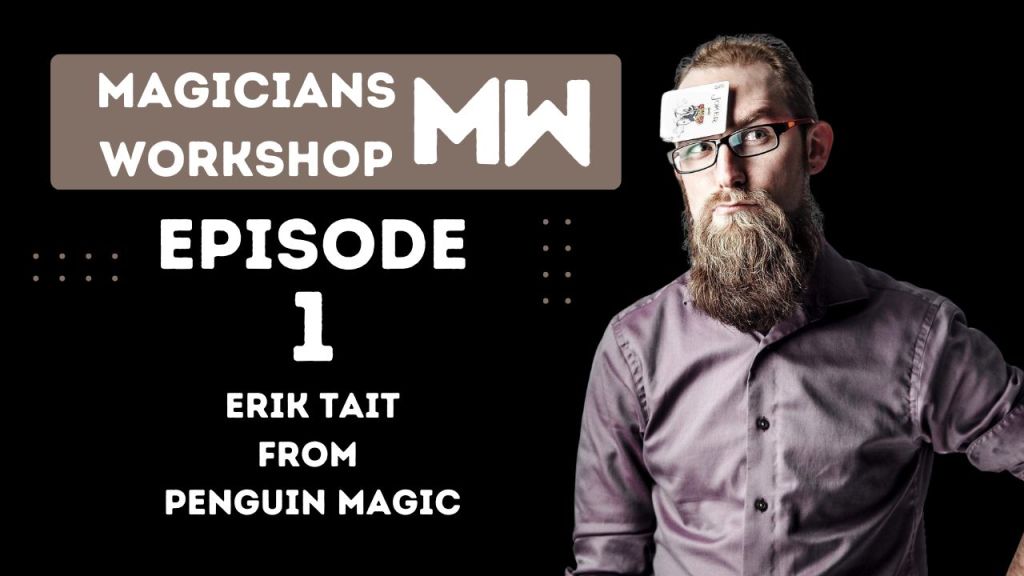
Meeting Award-Winning Magician Erik Tait
In today’s episode of The Magician’s Workshop, I had the immense pleasure of sitting down with the incredibly talented Erik Tait. For those unfamiliar, Erik is not just any magician—he’s an award-winning performer whose accolades include winning the International Brotherhood of Magicians Gold Cups Close-Up Competition in 2018 and becoming the first American in 20 years to stand on the podium for card magic at FISM, the World Championships of Magic, where he secured third place in 2022.
You might recognize Erik from his appearance on Penn & Teller: Fool Us or from performances at prestigious venues like the Magic Castle in Hollywood and Second City Toronto. With a degree in Comedy Writing and Performance from Humber College in Toronto, Erik is uniquely qualified to blend humor with his magical craft. As a producer at Penguin Magic, he’s responsible for some of their most popular effects, including Gasp and my personal favorite, Ultra Lucky Coin.
From the get-go, Erik’s energy was palpable. “Hi Dr. Todd, how are you?” he greeted me warmly, despite having spent the entire day feverishly editing comedy videos for Penguin Magic’s upcoming Holiday Special. “I just finished my last thing today, so now I get to get back to my regularly scheduled job.”
As a self-proclaimed Penguin Magic enthusiast, I couldn’t hide my excitement. “I’m actually, I’m sorry. I’m a little bit of a Penguin Magic Stan, if that’s the right way to say it.”
Erik chuckled, “Absolutely. No, it’s okay. I get it. I was a Penguin Magic fan for a long time before I joined the company.” He reflected on how surreal it felt to work there, having admired magicians like Oz Pearlman and Jay Noblezada in his early days. “Now I’m doing the same thing they were, which is just wild to me.”
This naturally led to the question of his first memory of getting into magic. Erik shared that his journey happened in stages. As a young boy, his father took him to a magic shop in an Atlanta hotel, where he got his first set of cups and balls and a nickels-to-dimes trick. But it wasn’t until middle school, when he learned to juggle, that magic began to take a serious hold on him.
“I got a gig at the Comedy Barn in Pigeon Forge, Tennessee,” Erik recounted. The owner assumed that as a juggler, he must know magic and assigned him to sell tricks in their magic shop. “I didn’t really know anything. I had a vague idea of the Svengali deck, but I wasn’t really a magician.” That changed when ventriloquist Steven Knowles taught him his first card moves. “I fell in love with a deck of cards and I’ve had one in my hand ever since.”
As Erik described, his passion for magic and his professional journey began simultaneously. While juggling on stage, he spent his off-hours selling classic tricks like the Svengali deck, cups and balls, and the invisible deck, honing his skills as both a performer and a pitchman.
When asked about his early influences, Erik’s face lit up with nostalgia. He credited the World’s Greatest Magic specials on NBC as a pivotal inspiration. “Those were huge, must-see TV events. Everyone saw them.” Magicians like Lennart Green, Julianna Chen, Michael Ammar, Daryl, and Mac King left lasting impressions on him. “My first proper magic book was Expert Card Technique by Hugard and Braue, which I bought in a used bookstore. It happened to be a first edition that I still have to this day.”
Erik also reminisced about the early days of magic on the internet, with companies like Ellusionist and Penguin Magic playing a huge role. “I was a member of the Black Club,” he proudly admitted, referring to Ellusionist’s exclusive club for magic enthusiasts. “I still have an unopened brick of first edition Black Tiger cards.”
Our conversation also delved into his favorite venues to perform. From the close-up gallery at the Magic Castle to the P3 Magic Theater he helped build, Erik’s passion for close-up magic was evident. But he also cherishes the larger stages, like the Chicago Magic Lounge’s Blackstone Theater, where he performed his first full-time show after leaving his corporate job in plastics manufacturing.
Stay tuned for Part Two, where we’ll dive deeper into Erik’s t insights into his creative process at Penguin Magic. You won’t want to miss it!
n part two of my interview with Erik Tait, we dive deep into what it’s like working at Penguin Magic and how his unique skill set led him to become an integral part of their team. Erik shares some fascinating insights into how being a magician is only part of the equation when it comes to magic production companies like Penguin.
One of the keys to joining a company like Penguin Magic, Erik reveals, is having a dual passion for both magic and the technical side of media—particularly photography, videography, and editing. His journey to Penguin wasn’t just about his magical skills; it was also about his fascination with photography and video production, which began long before he got involved with the magic world professionally.
Before joining Penguin, Erik spent years traveling and photographing wildlife in South America, experimenting with GoPro videos, and editing comedy sketches with his friends. His experience in videography made him the perfect candidate when Penguin needed someone with both a creative mind and technical know-how to handle video production. It wasn’t just about doing the tricks but also creating a polished final product—something that Penguin Magic values immensely.
Erik also emphasizes the importance of understanding the customer experience when it comes to magic tutorials. In his role, he’s focused on improving how magic is taught to ensure that new learners have a positive, accessible entry into the world of magic. As he explains, magic products should be designed with everyone in mind, from seasoned magicians to complete beginners. It’s about making sure that new magicians feel supported from the moment they receive their first trick, especially since everyone has to start somewhere.
We also discuss how Erik’s background in teaching—especially through his own experience with Montessori education—shapes his approach to teaching magic. He doesn’t just want to show you how to perform a trick; he wants to teach you how to teach yourself, which is a critical skill for every aspiring magician.
Erik also opens up about the evolution of the Penguin Magic website and how the team is working hard to make it even more user-friendly. Although the site is huge, Erik assures that there’s a lot of behind-the-scenes effort going into upgrading the platform to make it more navigable for users, especially newcomers to magic. Even though the site might look a little outdated to some, Erik emphasizes the monumental challenge of maintaining such a large database of products, tutorials, and reviews.
The process of creating and launching magic products at Penguin Magic is intricate and multifaceted. Erik Tait explains that the journey begins with the submission of ideas from creators, often in rough forms, such as prototypes made from basic materials like sticky tape or felt. These submissions must include two essential elements: a performance video and an explanation video. The submission is then reviewed by a group of magicians with expertise in various areas, from card tricks to mentalism, to ensure the idea holds merit and isn’t a mere variation of a past concept.
Once a product is selected, it enters a phase of refinement. Erik and the team at Penguin work closely with Seth Race, the head of manufacturing, to transform rough ideas into workable prototypes. The focus is on ensuring that the final product is not only effective but also practical for magicians performing in real-world settings. This process often involves testing the product in live environments to identify and address potential flaws before it reaches the public. This attention to detail is key to maintaining the quality of the products that Penguin Magic is known for.
What sets Penguin Magic apart is the involvement of magicians throughout the production process. Rather than relying solely on non-magical manufacturing teams, the company ensures that magicians with practical knowledge oversee the quality control and manufacturing phases. This approach significantly reduces the likelihood of product flaws or returns, which is one reason why Penguin has such a low instance of returns on their products.
Erik also emphasizes the importance of the creative team being well-versed in magic history and techniques. Many ideas are rejected because they are based on existing concepts from past masters like Ken Crenzel or Pat Page. Having a knowledgeable team helps ensure that only original and innovative ideas make it through to production.
The process of creating a new magic product is complex, but the results speak for themselves. The combination of thorough testing, feedback from magicians, and careful consideration of every detail ensures that each product released by Penguin Magic has been road-tested for real-world performance. Whether it’s the innovative Ultra Lucky Coin or a new mentalism effect, Penguin Magic continues to maintain its reputation as a leader in the magic industry by fostering creativity and maintaining high production standards.
From in-house manufacturing by magicians to the world of Penguin Live lectures, it’s clear that Erik’s dedication to the craft of magic is unwavering. We hope you enjoyed this deep dive into the magic world! If you liked this post, don’t forget to leave a comment and give it a like—your feedback is always appreciated!
-Dr. Todd

 The Magician's Workshop Blog
Leave a comment